
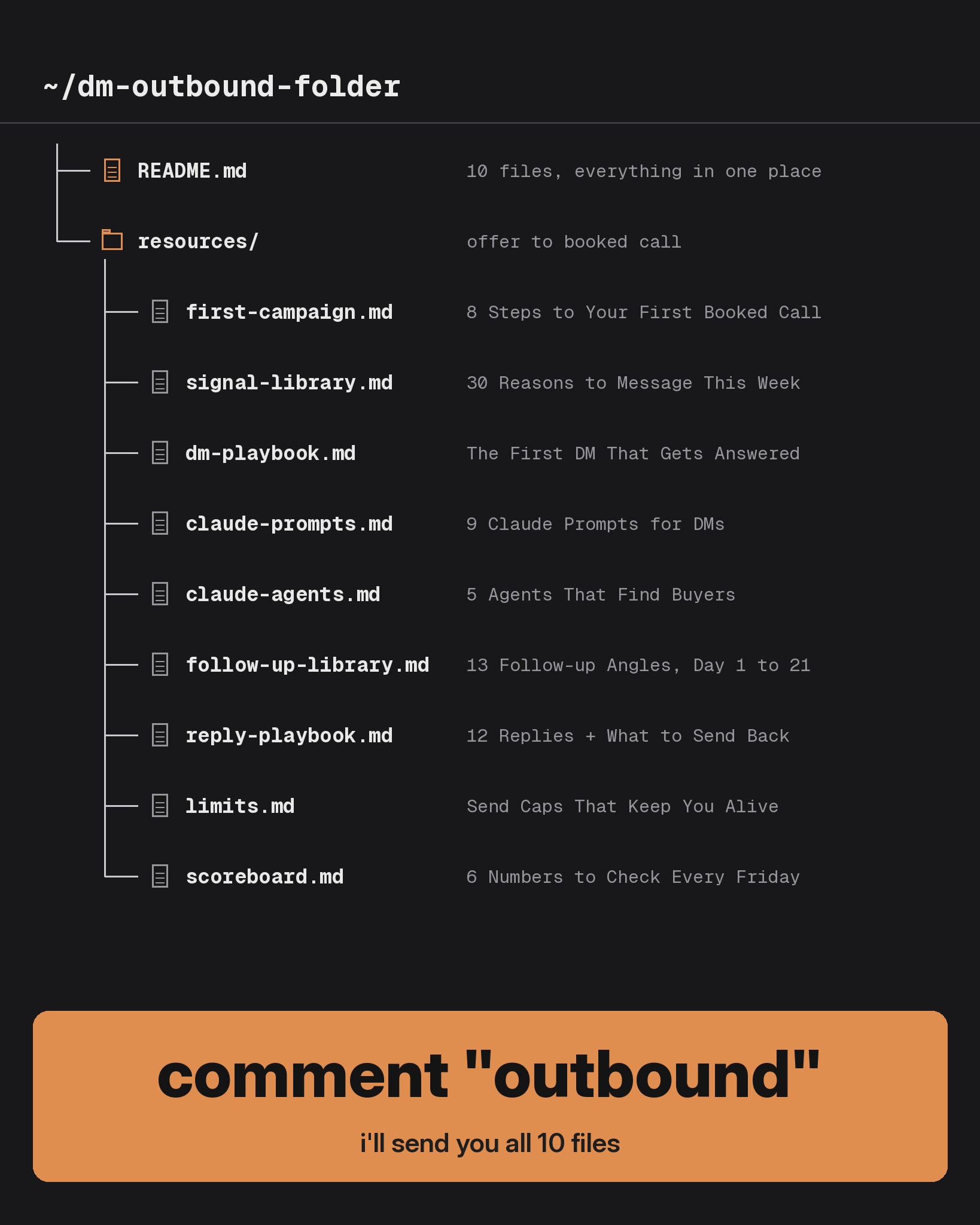
CTA word: OUTBOUND
Ten files for booking calls from LinkedIn and X DMs without sounding like a cold email. Every file is short on purpose: you should be able to read it, copy it, and send your first batch the same day.
What's in the folder:
- README.md - how the pieces fit together
- first-campaign.md - one offer to a booked call in 8 steps
- signal-library.md - 30 reasons to message someone this week
- dm-playbook.md - the anatomy of a first DM that gets answered
- claude-prompts.md - 9 Claude prompts for research, drafting and fixing DMs
- claude-agents.md - 5 small agents that find people worth messaging
- follow-up-library.md - 13 follow-up angles, day 1 to day 21
- reply-playbook.md - the 12 replies you'll get and what to send back
- limits.md - send caps and habits that keep your account alive
- scoreboard.md - the 6 numbers to check every Friday
README.md
DMs work when they read like one person noticing something about another person. They fail when they read like a sequence. Everything in this folder pushes you toward the first and away from the second.
The loop:
- Pick one offer for one kind of buyer (first-campaign.md).
- Each morning, find people with a reason to talk now (signal-library.md, claude-agents.md).
- Write a short first DM that names the reason and asks one easy question (dm-playbook.md, claude-prompts.md).
- Follow up with new information, never "just bumping this" (follow-up-library.md).
- Answer replies fast, and move good ones to a calendar link or a time (reply-playbook.md).
- Stay under your caps (limits.md) and check your numbers on Friday (scoreboard.md).
Claude does the research and the first draft. You do the judgment and you hit send.
first-campaign.md - offer to booked call in 8 steps
1. Write the offer in one sentence
Format: "I help [specific buyer] get [specific outcome] in [time frame] without [thing they hate]." If you can't fill all four blanks, you're not ready to message anyone.
2. Pick one buyer, not a market
A job title + company size + one situation. "Ops leads at 50-300 person logistics companies who just opened a second warehouse" beats "logistics companies."
3. List 3 situations where the offer is urgent
These become your signals. Hiring for the role you'd replace, a new location, a public complaint, a funding round, a tool migration.
4. Build a list of 50, not 5,000
Fifty people who fit, each with the situation written next to their name. Small lists force better messages.
5. Warm the account for 2-3 days
Follow, like or comment on something real they posted. Not required, but it lifts accept and reply rates and makes your name familiar.
6. Send the first DM (dm-playbook.md)
Reason, one line of relevance, one question. Under 300 characters.
7. Follow up twice with something new (follow-up-library.md)
Day 3-4 and day 8-10. Each follow-up adds a fact, an example or a resource.
8. Ask for a specific time
When someone engages, don't send a paragraph. Send: "easier to show you than type it - 15 min thursday or friday?" plus your link.
signal-library.md - 30 reasons to message someone this week
A signal is a public fact that makes your message timely. Always keep the source link next to the name so you can check it before you send.
Hiring signals
- Posted a job for a role your offer replaces or supports
- Posted the same job twice in 90 days (it isn't getting filled)
- Hiring their first person in a function (first RevOps, first data hire)
- A leader in the function just joined (new VPs buy in their first 90 days)
- A key person in the function just left
Company change signals
- Raised a round in the last 60 days
- Opened a new office, warehouse, store or region
- Launched a new product or pricing page
- Announced a partnership or integration
- Acquired a company or got acquired
- Moved upmarket (new "enterprise" page, new case studies)
- Rebranded or relaunched the website
Pain signals
- Public complaint about a tool you replace or fix
- Bad reviews mentioning slow support, missed deliveries, or errors
- Founder posted about being stretched thin
- Asked for recommendations in a public thread
- Job post mentions "manual," "spreadsheets," or "scrappy"
- Status page shows repeated incidents
Content signals
- Posted about the exact problem you solve
- Commented on a competitor's post
- Engaged with your post (like, reply, repost)
- Spoke on a podcast or panel about the topic
- Wrote a "lessons learned" thread that names a gap
Tech and stack signals
- Started using a tool your offer plugs into
- Stopped using a tool (removed from site, job posts changed)
- Migrating systems (CRM, ERP, helpdesk)
- Started building with AI and posting about it
Relationship signals
- Mutual connection just worked with them
- They follow two or more people in your circle
- They attended or registered for the same event
Rule: one signal per message. Stacking three signals reads like surveillance.
dm-playbook.md - the first DM
The shape
- The reason - the signal, in plain words
- The bridge - one line on why that made you think of them
- The question - easy to answer in under ten words
Example
saw you're hiring a second ops coordinator in 3 months. usually means the inbox is eating someone's week. are you handling order exceptions by hand right now or is something triaging them?
Rules
- Under 300 characters for the first DM
- No link in the first message
- No "hope you're well," no "quick question," no "I'd love to"
- Lowercase or normal casing is fine; corporate formatting is not
- Ask about their situation, not about a meeting
- Never paste the same message twice in a row; rewrite the first line every time
What a bad DM looks like
Hi John, I hope this message finds you well! I'm the founder of X, we help companies like yours leverage AI to drive efficiency. Would you be open to a quick 15-minute call next week?
It has no reason, no bridge, and asks for time before earning it.
claude-prompts.md - 9 prompts
Paste these into Claude. Replace the brackets.
1. Offer sharpener "Here's my offer: [offer]. Rewrite it as one sentence in the form 'I help [buyer] get [outcome] in [time] without [pain].' Give 5 versions, each for a narrower buyer. Tell me which is most specific and why."
2. Buyer situations "For [buyer], list 10 public situations that would make [outcome] urgent this month. For each, say where I could see it (job board, LinkedIn post, website, news)."
3. Profile research "Here's a profile and their last 5 posts: [paste]. Give me the one fact most relevant to [offer], the source line it came from, and one question I could ask about it. If nothing is relevant, say 'skip.'"
4. First DM draft "Write a first DM under 280 characters. Reason: [signal]. Bridge: [why it matters for my offer]. End with one question they can answer in under 10 words. No link, no pleasantries, no pitch. Give 3 versions."
5. DM critic "Here's my DM: [paste]. Score it 1-10 on: sounds like a person, has a real reason, easy to answer. Point out any phrase that sounds like a template or AI. Rewrite it once."
6. Follow-up with new information "My first DM was [paste]. They haven't replied. Write a follow-up that adds one new fact, example or resource relevant to them. Under 200 characters. Never say 'bumping' or 'following up.'"
7. Reply classifier "Here's a reply: [paste]. Which of these is it: interested, curious, timing, not me, price, already have something, no. Draft my answer using reply-playbook.md style."
8. Objection to question "They said: [objection]. Turn it into a question that helps me understand their situation instead of arguing. Give 3 options."
9. Weekly review "Here are this week's sends, replies and booked calls: [paste table]. Which signals and first lines got the most replies? What should I stop doing? Keep it to 5 bullets."
claude-agents.md - 5 small agents
Each one is a short Claude instruction you run on a schedule (Claude Code, a cron job, n8n, or by hand each morning). Each agent does one job and writes to the same sheet.
1. Job-post watcher
- Input: a list of target companies or a job-board search
- Does: flags new posts for roles your offer replaces or supports; writes company, role, link, date
- Output: new rows with signal type "hiring"
2. News and funding watcher
- Input: your buyer description
- Does: checks funding, expansion and launch news from the last 7 days; keeps only companies that fit
- Output: rows with signal type "company change" and the article link
3. Post listener
- Input: 5-10 keywords your buyers use when they're in pain
- Does: finds recent posts with those words from people who fit the buyer; drops vendors and job seekers
- Output: rows with signal type "pain" or "content" and the post link
4. Researcher
- Input: each new row
- Does: reads the profile and recent activity, picks the single most relevant fact, or marks the row "skip"
- Output: one fact + source line per person
5. Drafter
- Input: rows with a fact
- Does: writes 2 first-DM options using prompt 4
- Output: drafts in the sheet. You pick, edit and send. The agent never sends.
Guardrails for all five: keep the source link on every row, dedupe against people you've already messaged, and cap the daily output at what you can actually review.
follow-up-library.md - 13 angles, day 1 to 21
Two or three follow-ups max. Each one must give them something new.
| Day | Angle | Example |
|---|---|---|
| 1 | The first DM | (dm-playbook.md) |
| 3 | A specific example | "one ops team we talked to cut exception triage from 3 hours a day to 30 min. happy to share how" |
| 3 | A useful resource | "made a one-page checklist for exactly this, want it?" |
| 4 | A sharper question | "simpler question: who on your team touches order exceptions first?" |
| 5 | Their own content | "your post about [topic] is the exact thing I meant, the part about [detail]" |
| 7 | A small insight | "most teams we see lose the time in the handoff, not the task itself" |
| 7 | A peer reference | "a few [role]s at [similar company type] are solving this with [approach]" |
| 8 | A change in the market | "saw [news] this week, guessing that makes [problem] louder for you" |
| 10 | A short video or screenshot | "recorded 60 seconds on how this would look for you: [link]" |
| 10 | The opposite view | "honestly you might not need this if [condition], curious if that's you" |
| 14 | Permission to close | "should I stop bugging you about this? totally fine either way" |
| 14 | Different person | "is there someone else on the team who owns this?" |
| 21 | Fresh start with a new signal | Only if a new signal appears. Otherwise stop. |
Rules: never "just bumping," never guilt, stop at the first "no."
reply-playbook.md - 12 replies and what to send back
| They say | You send |
|---|---|
| "Interesting, tell me more" | One sentence on the outcome, then: "easier to show you - 15 min thursday or friday?" |
| "What does it cost?" | "depends on scope, usually [range]. worth 15 min to see if it even fits?" |
| "Send me some info" | "sure - what would make it worth reading? [problem A] or [problem B]?" then send one page, not a deck |
| "Not right now" | "makes sense. when would be better to check back, next quarter?" Set the reminder. |
| "We already use [tool]" | "nice, how's it handling [specific weak spot]?" |
| "We do it in-house" | "good call. curious who owns it - is it someone's full job or on top of their job?" |
| "I'm not the right person" | "appreciate it - who would be?" |
| "How did you find me?" | Tell the truth: "saw your post about [topic]" or "saw you're hiring for [role]." |
| "Is this automated?" | "the research is, the message isn't. I read your [thing] before writing." Only say it if it's true. |
| "Not interested" | "all good, thanks for telling me." Stop. |
| A one-word reply ("sure," "ok") | Send the time options right away. |
| No reply after 2 follow-ups | Stop. Revisit only with a new signal. |
Speed matters more than polish: answer within a few hours during the workday.
limits.md - keep your account alive
- LinkedIn: stay around 20-25 connection requests and 30-50 DMs a day on a normal account; ramp new accounts slowly over 2-3 weeks
- X: keep new-conversation DMs low (start around 20 a day, no more than about 5 an hour) and spread them through the day
- Never send identical text to many people in a row
- Don't put links in first messages
- Pause for a week if acceptance or reply rates drop sharply or you get a warning
- Keep a do-not-message list and honor every "stop"
These numbers are conservative starting points, not platform guarantees. Platforms change limits without notice, so watch for warnings and back off when you see one.
scoreboard.md - 6 numbers every Friday
| Number | What it tells you | Healthy starting range |
|---|---|---|
| First DMs sent | Volume | 50-150 a week |
| Reply rate | Is the first line working? | 15%+ |
| Positive reply rate | Is the offer working? | 5%+ |
| Calls booked | Are you asking for the time? | 2-5 a week |
| Show rate | Are you confirming? | 75%+ |
| Best signal | Which reason to message got the most replies | Do more of it next week |
If reply rate is low, fix the first line and the signal. If replies are high but calls are low, fix how you ask for time. If calls are high but nothing closes, fix the offer.
That's the folder. Pick one offer, find 50 people with a reason to talk this week, and send the first ten tomorrow morning.